
Talent is leaving: Charlotte Center for the Arts chases a $150M hub for South Charlotte |
Charlotte Center for the Arts is building support for a proposed three-phase project, starting with a feasibility study and aiming toward a planned Community Arts Hub and flagship campus |
Charlotte has no shortage of creative people.
The problem, according to Charlotte Center for the Arts, is finding affordable places for them to perform, rehearse, exhibit and teach.
The nonprofit was founded in 2023 with a specific concern: Charlotte's arts infrastructure has not kept pace with the city's growth.
As South Charlotte expands around Ballantyne, Pineville, I-485 and nearby corridors, dedicated arts facilities remain limited.
Charlotte Center for the Arts is now pursuing a long-term vision that could reach $150 million.
But the flagship campus is not built, and the planned Community Arts Hub is not yet funded.
The immediate goal is more practical: raise money for a feasibility study and build the partnerships needed to move the idea forward.
For local residents, artists and small businesses, there is a concrete way to help today.
The problem: talent is leaving
Charlotte Center for the Arts says local artists are leaving because affordable performance and exhibition space is scarce.
That shortage affects more than professional performers.
It can also limit where students take classes, where working artists develop their craft and where residents experience local music, theater, dance and visual art.
The issue is especially visible outside Uptown.
Artists may have difficulty finding spaces that are affordable, available and large enough for their needs.
Residents in South Charlotte may also have to travel farther for cultural programs, depending on the event and venue.
This is the central argument behind the initiative: A growing city needs arts infrastructure that grows with it.
The proposed project is not simply about constructing a large building.
It is about creating more options for artists and audiences, including classrooms, galleries, rehearsal areas, performance venues and community gathering space.
The three-phase plan
Charlotte Center for the Arts has outlined a three-phase plan.
Each phase is planned, and none should be read as a completed or fully funded project.
Planned near term: adaptive reuse
The first step is a proposed $4 million to $5 million adaptive reuse project.
The goal is to activate 30,000 to 40,000 square feet of existing commercial space rather than wait for a new campus to be built.
This phase would give the organization a way to begin programming and address immediate space needs.
Adaptive reuse could also bring new life to underused commercial property in South Charlotte.
The organization has discussed existing commercial areas near major South Charlotte destinations as potential locations, but a final site has not been announced.
Planned within three years: Community Arts Hub
The second phase is a proposed 20,000 to 30,000 square foot Community Arts Hub.
Charlotte Center for the Arts says the hub would serve 300 to 400 or more students and working artists.
Planned uses include performance space, classrooms, artist studios, galleries and areas for community programming.
This hub is not yet built or funded.
Its size and programming will depend in part on the feasibility and market studies now being pursued. |
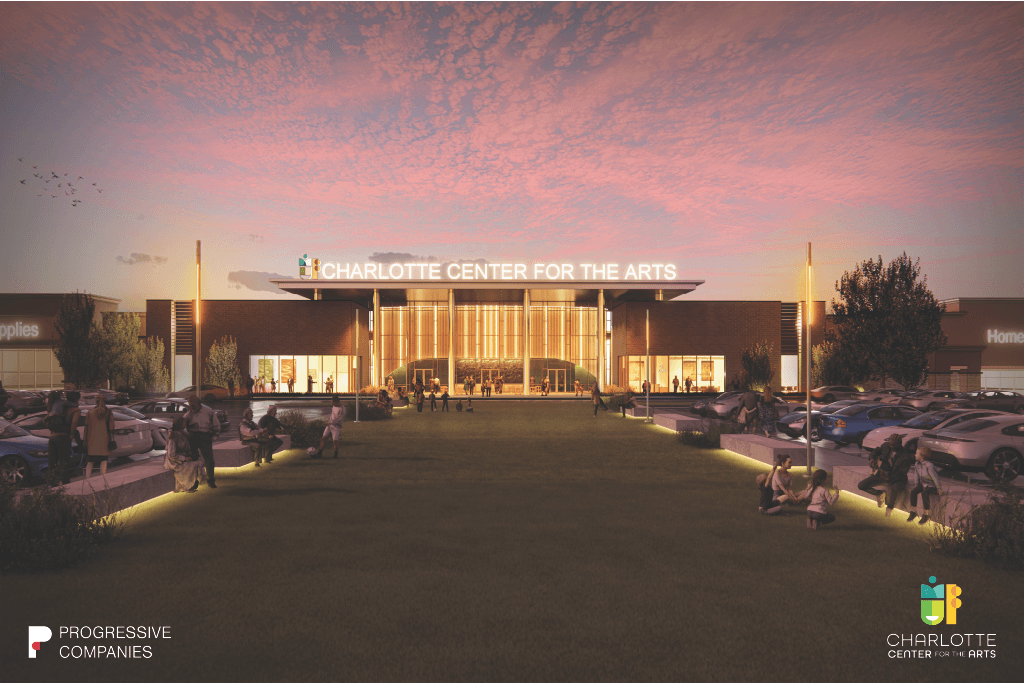 Conceptual rendering shown on the Charlotte Center for the Arts initiative page. This is a planned project, not an existing facility. |
Planned long term: flagship campus
The third phase is the biggest piece of the vision: a planned 100,000 square foot flagship campus.
The proposed campus would include a 1,000-seat proscenium theater, a 250 to 400 seat black box theater, rehearsal space, galleries, classrooms and an outdoor performance area.
The $150 million figure refers to the broader long-term vision for this flagship arts destination.
It is not a current construction budget for a project that is already underway. |
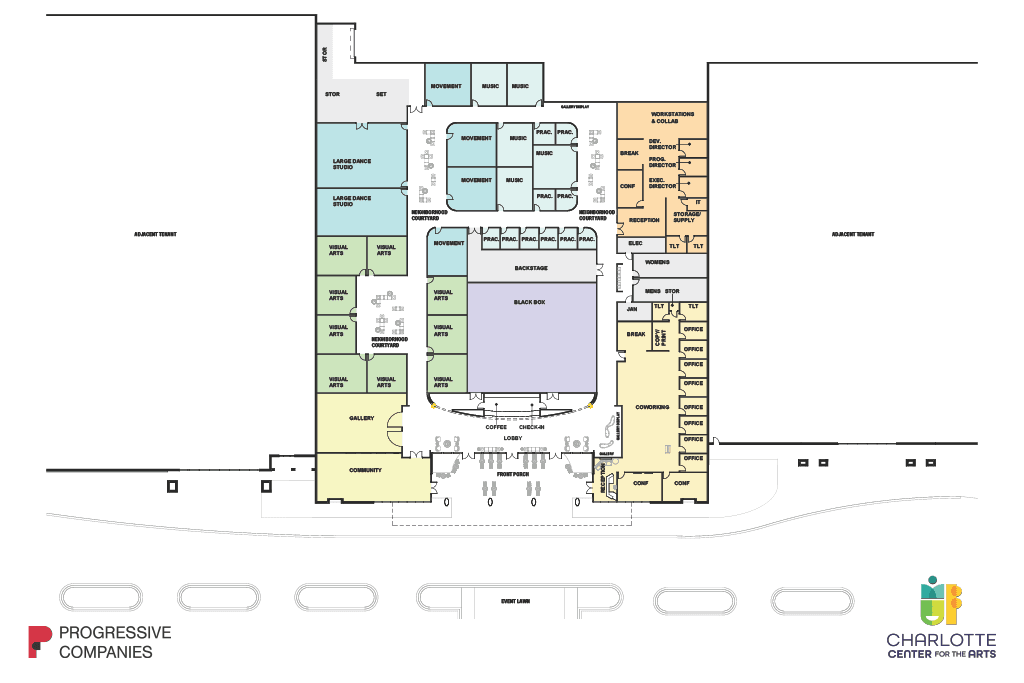 Conceptual floor plan provided on the Charlotte Center for the Arts initiative page. |
Why South Charlotte and why geography matters
South Charlotte is one of the fastest-growing parts of the region, but it has few dedicated arts facilities.
That geography matters.
Arts access is not only about whether Charlotte has cultural organizations.
It is also about where those organizations, venues and classrooms are located.
The City's 2023 State of Culture Report noted that more than 50 cultural amenities are concentrated in Uptown, while Charlotte-Mecklenburg's Corridors of Opportunity have fewer than 30 physical arts and culture assets.
Those numbers point to an uneven map.
Uptown remains an important cultural center, but residents outside the center city may have fewer nearby choices.
For someone living or working in South Charlotte, distance, transportation, parking and scheduling can all affect whether attending a performance or class is realistic.
A South Charlotte arts facility would not replace Uptown venues.
The goal would be to add capacity in a part of the region that is growing and to make more arts experiences available closer to where people live.
The proposed location would also connect with major South Charlotte corridors, including areas around Ballantyne, Pineville-Matthews Road, Providence Road, Ardrey Kell Road and Johnston Road.
That could give the future hub a broad potential audience, although no final site has been selected.
The roadmap at a glance
Charlotte Center for the Arts has outlined the following planned timeline.
Years 1-2, 2025-2026: Awareness and early organizational development.
Years 3-5, 2027-2029: Fundraising and partnerships.
Years 6-7, 2030-2031: Planned groundbreaking and construction.
Year 8, 2032: Planned ribbon cutting and first season.
This is a roadmap, not a guarantee that construction or opening dates are locked in.
The organization still needs to complete feasibility work, build partnerships and secure funding before the larger phases can move ahead.
That is why the current campaign matters.
The immediate fundraising target is for planning, not for building the 100,000 square foot campus. |
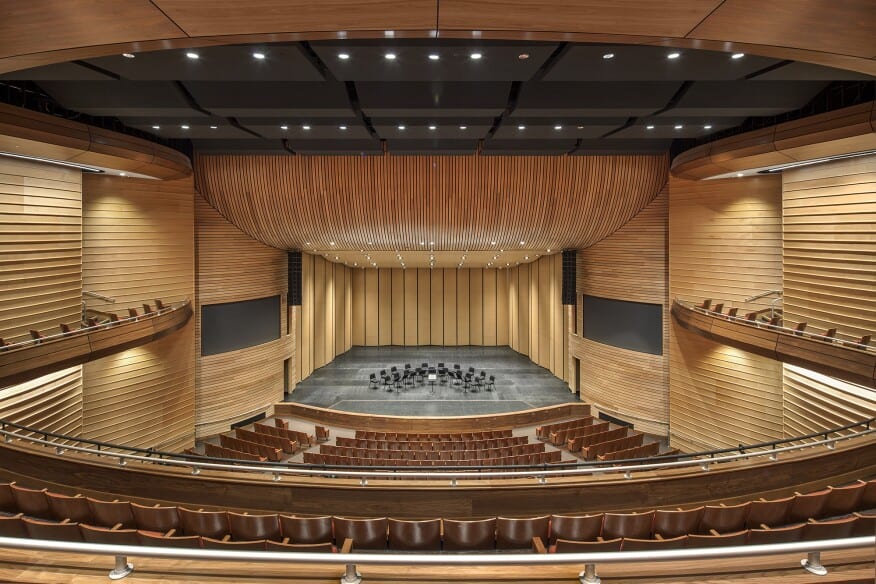 Reference image shown by Charlotte Center for the Arts. This is not an image of a Charlotte Center for the Arts facility. |
How you can help right now
The most direct way to support the project today is through the Crown Charlotte's Talent fundraising campaign.
The campaign has raised $25,364 toward a $30,000 feasibility study goal.
That study is intended to help answer important questions about demand, programming, operations, location and the future Community Arts Hub.
In plain terms, this is the step that helps determine what is realistic before larger fundraising and construction plans begin.
You can support the campaign by visiting artscenterclt.org/donate.
Donations can help Charlotte Center for the Arts continue its planning work and build momentum with artists, residents, schools, businesses and potential development partners.
You can also share the campaign with local performers, teaching artists, arts organizations and neighbors who want more creative activity in South Charlotte.
The takeaway
Charlotte Center for the Arts is responding to a clear local concern: Charlotte is growing, but affordable arts space has not kept pace.
The proposed plan starts with adaptive reuse and a feasibility study.
It could eventually lead to a Community Arts Hub serving hundreds of students and artists, followed by a planned flagship campus with major performance, education and exhibition spaces.
None of those larger facilities are built today, and the long-term vision is not yet funded.
But the fundraising campaign is active now, and the feasibility study is a concrete first step.
Want to help keep Charlotte's local talent in Charlotte?
Visit artscenterclt.org/donate, learn about the plan and share the campaign with someone who believes South Charlotte deserves more places to create, perform and gather.
For more stories about the people and organizations making an impact across the Carolinas, keep reading Carolina Impact Weekly.
Sources: Charlotte Center for the Arts initiative page, Charlotte Center for the Arts donation page and Charlotte Observer coverage. |
0 Comments
Join the conversation
Be the first to comment
Share your thoughts above.